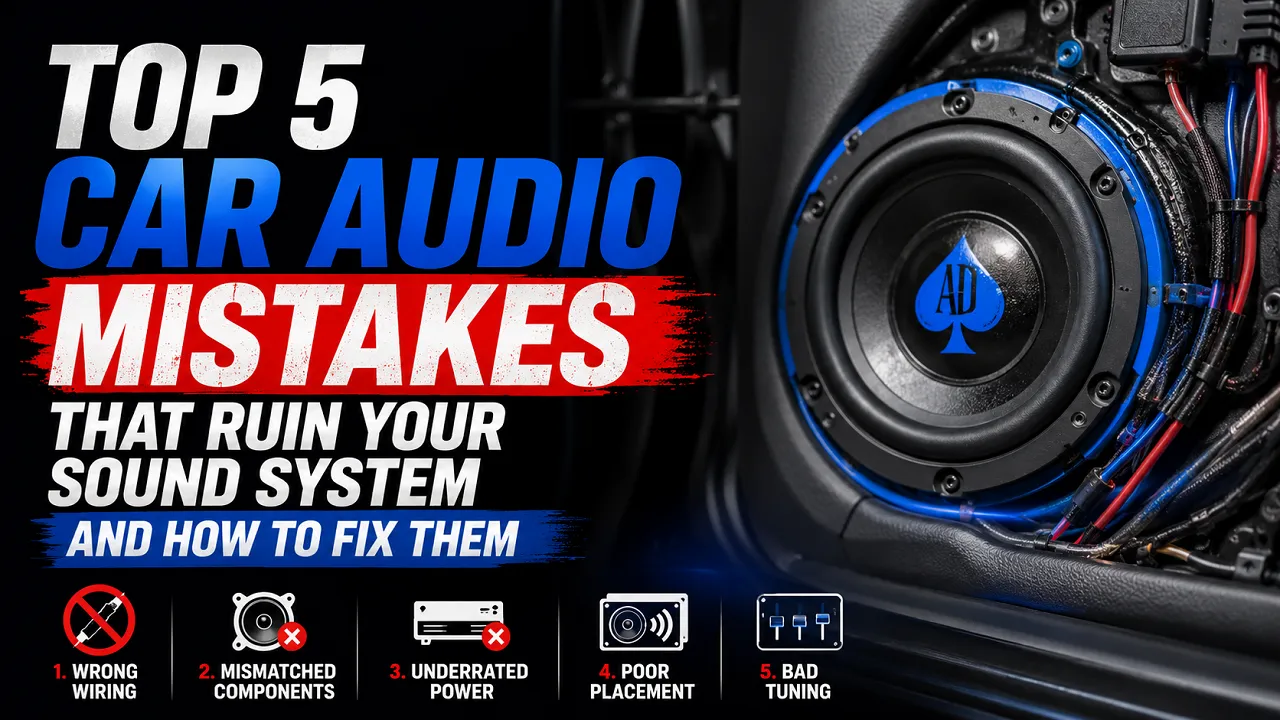
Understanding the Top 5 Car Audio Mistakes That Ruin Your Sound System
A great sound system isn’t built by expensive equipment alone. Understanding the Top 5 Car Audio Mistakes That Ruin Your Sound System can help you avoid poor performance and enjoy every drive with clear, balanced audio. Many common car audio mistakes happen during installation or component selection, preventing drivers from experiencing the full benefits of a car audio system upgrade. Whether you’re looking for how to improve car audio quality or searching for the best car audio installation tips, avoiding these mistakes will help you achieve cleaner sound, stronger bass, and better overall performance.
Mistake 1: Choosing Poor-Quality Speakers or Incorrect Speaker Placement
Speakers are the foundation of every car audio system. Even the best amplifier cannot compensate for speakers that produce inaccurate sound or are installed incorrectly.
Many factory-installed speakers use lightweight materials that wear out over time. They often struggle to reproduce deep bass, detailed vocals, and crisp high frequencies, limiting the overall listening experience.
Poor speaker placement creates another problem. If tweeters are mounted too low or subwoofers are installed inside unsuitable enclosures, sound staging becomes uneven and music loses its natural balance.
How to Fix It
A quality car audio system upgrade should begin with premium speakers that match your listening preferences.
Consider these improvements:
- Install component speakers for better imaging.
- Position tweeters closer to ear level.
- Select the correct enclosure for your subwoofer.
- Secure all speakers firmly to eliminate vibrations.
- Choose speakers that match your amplifier’s power output.
Following these best car audio installation tips allows your speakers to perform more accurately while improving overall clarity.
Mistake 2: Using the Wrong Amplifier or Skipping One Completely
One of the most common car audio mistakes is relying solely on the factory head unit to power aftermarket speakers.
Factory stereos usually deliver limited RMS power, making it difficult for upgraded speakers to perform properly. The result is weak output, distortion at higher volumes, and poor dynamic range.
Using an amplifier with incorrect power ratings can also create problems. Too little power often causes clipping, while excessive power can damage speakers if gains are not adjusted correctly.
How to Fix It
Selecting the correct amplifier is essential for how to improve car audio quality.
Keep these recommendations in mind:
- Match amplifier RMS power with speaker RMS ratings.
- Use mono amplifiers for subwoofers.
- Choose multi-channel amplifiers for full-range speakers.
- Adjust gain controls correctly.
- Configure crossover settings properly.
A professionally tuned amplifier delivers cleaner sound while protecting your equipment from unnecessary stress.
Mistake 3: Ignoring Sound Deadening Materials
Many people invest in expensive speakers and amplifiers but forget about road noise.
Vehicle doors, floor panels, roofs, and trunks constantly vibrate while driving. These vibrations compete with your music and reduce overall sound quality.
Even after a major car audio system upgrade, excessive cabin noise can prevent you from hearing the improvements you’ve paid for.
How to Fix It
Installing sound-deadening materials is one of the best car audio installation tips for improving listening quality.
Popular installation areas include:
- Front and rear doors
- Floor panels
- Roof
- Trunk
- Wheel wells
Quality sound-deadening products reduce vibrations, minimize outside noise, and create a quieter environment where your speakers can perform more efficiently.
They also help eliminate unwanted rattles caused by powerful subwoofers.
Why These Three Mistakes Affect Overall Sound Quality
Each of these common car audio mistakes weakens a different part of your audio system.
Poor speakers reduce accuracy.
Improper amplification limits performance.
Excessive vehicle noise hides musical detail.
Correcting these problems together produces a much greater improvement than upgrading only one component, making your investment in a car audio system upgrade far more effective.
Mistake 4: Relying on Factory Equalizer Settings Instead of Proper Tuning
Many drivers spend money on new speakers and amplifiers but never tune the system correctly. This is one of the most common car audio mistakes because factory equalizer settings are designed to work with factory speakers—not aftermarket equipment.
Every vehicle has unique interior acoustics. Glass windows, plastic panels, seats, and dashboard surfaces all affect how sound travels through the cabin. Without proper tuning, you may notice muddy bass, harsh treble, weak vocals, or an unbalanced soundstage.
How to Fix It
Learning how to improve car audio quality requires proper system tuning after installation.
You can improve your system by:
- Using a Digital Signal Processor (DSP) for accurate tuning.
- Setting crossover frequencies correctly.
- Making small equalizer adjustments instead of extreme boosts.
- Adjusting speaker time alignment for better imaging.
- Having your system professionally calibrated.
A DSP allows every speaker to perform at its full potential while creating a balanced and natural listening experience. Following these best car audio installation tips helps eliminate frequency imbalances and improves overall sound quality.
Mistake 5: Listening to Low-Quality Music Files
Even the most expensive speakers cannot improve poor-quality audio recordings. This is one of the Top 5 Car Audio Mistakes That Ruin Your Sound System because the source audio determines what your system can reproduce.
Highly compressed music files lose important audio information during compression. As a result, vocals may sound dull, bass becomes less detailed, and high frequencies lose clarity.
Bluetooth streaming with older codecs can also reduce sound quality if both your phone and head unit do not support higher-quality audio transmission.
How to Fix It
One of the easiest ways to how to improve car audio quality is by using better music sources.
For the best results:
- Use FLAC or ALAC lossless audio files.
- Download high-bitrate 320 kbps MP3 files if lossless formats are unavailable.
- Subscribe to lossless music streaming services.
- Enable high-quality streaming settings within your music app.
- Use USB playback whenever possible for maximum audio quality.
Combining high-resolution music with a quality car audio system upgrade allows your speakers and amplifier to reproduce every detail more accurately.
Additional Best Car Audio Installation Tips
Whether you’re installing a simple speaker upgrade or building a complete custom system, following the best car audio installation tips helps maximize performance.
Remember to:
- Use quality power and ground wiring.
- Install properly shielded RCA cables.
- Secure every speaker and amplifier firmly.
- Match amplifier power to speaker specifications.
- Tune the system after installation.
- Check all wiring connections before final assembly.
Avoiding these common car audio mistakes improves both sound quality and long-term system reliability.
Understanding the Top 5 Car Audio Mistakes That Ruin Your Sound System can help you build a better-performing audio system without wasting money on unnecessary upgrades. Most problems are caused by incorrect installation, poor tuning, or mismatched components rather than expensive equipment.
A successful car audio system upgrade starts with quality speakers, the correct amplifier, proper sound deadening, accurate tuning, and high-quality music sources. By following proven methods for how to improve car audio quality and applying the best car audio installation tips, you can enjoy cleaner vocals, tighter bass, better imaging, and a more immersive listening experience every time you drive.
Frequently Asked Questions
What are the most common car audio mistakes?
The most common car audio mistakes include using poor-quality speakers, choosing the wrong amplifier, skipping sound-deadening materials, relying on factory equalizer settings, and playing low-quality music files.
How can I improve car audio quality without replacing everything?
If you’re wondering how to improve car audio quality, start by tuning your equalizer correctly, adding sound-deadening material, upgrading your speakers, and installing a properly matched amplifier before replacing your entire system.
Is a DSP necessary for a car audio system upgrade?
A DSP is not mandatory, but it greatly improves a car audio system upgrade by correcting speaker timing, equalization, and crossover settings. It allows your system to produce clearer and more balanced sound.
Why is speaker placement important?
Correct speaker placement creates a wider soundstage, improves stereo imaging, and helps vocals appear centered instead of sounding like they come from different directions.
Can factory stereos power aftermarket speakers?
Factory stereos can power basic aftermarket speakers, but they usually cannot provide enough clean power for premium components. Adding an amplifier delivers much better performance.
What music format provides the best sound quality?
Lossless formats such as FLAC and ALAC provide the highest sound quality. They preserve more musical detail than compressed MP3 files and allow your upgraded system to perform at its best.
Are professional installers worth it?
Yes. Professional installers understand wiring, tuning, acoustic adjustments, and the best car audio installation tips, ensuring every component works together safely and efficiently while avoiding costly installation mistakes.