How to Choose a Car Amplifier for Your Audio System
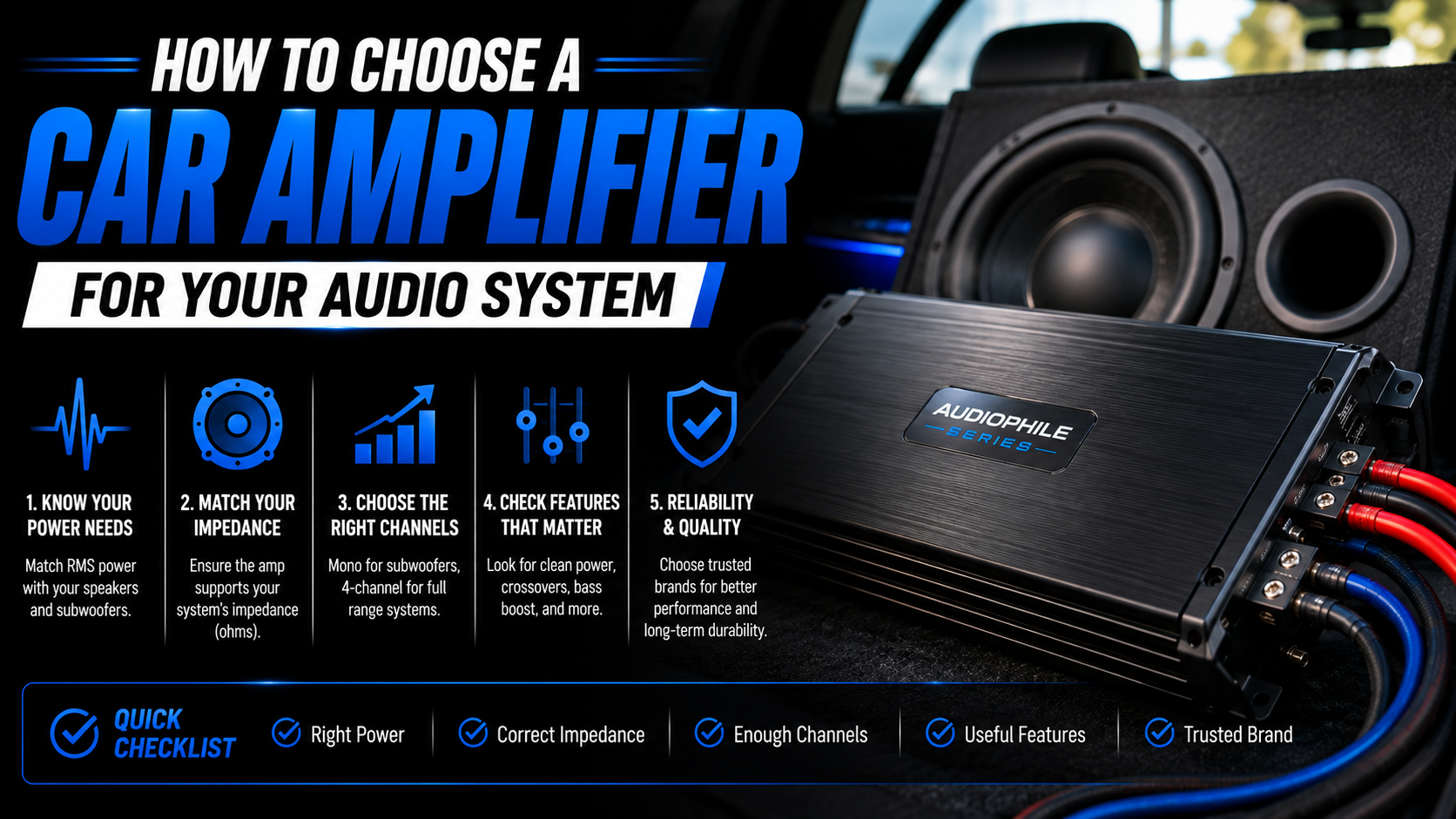
Learning how to choose a car amplifier for your audio system starts with understanding how much power your speakers and subwoofers actually need. Finding the best car amplifier for sound quality also means comparing car amplifier RMS power, selecting the right car amplifier channel configuration, and planning your car amplifier wiring correctly. A properly matched amplifier can deliver cleaner output, stronger dynamics, and better control without forcing your speakers to work beyond their limits.
What Does a Car Amplifier Actually Do?
A car amplifier takes the relatively low-power audio signal from your head unit or signal processor and increases its power so it can drive speakers and subwoofers effectively.
Factory head units are convenient, but their built-in amplification is often limited. When you add higher-performance speakers or a dedicated subwoofer, additional amplification can provide the current and power necessary for those components to perform properly.
A good amplifier can provide:
- Greater volume capability
- Improved dynamic range
- Better control over speakers
- Cleaner reproduction at higher listening levels
- More powerful and controlled bass
However, adding the biggest amplifier you can afford isn’t necessarily the right approach. The amplifier must be matched to the rest of the system.
Start With Car Amplifier RMS Power
One of the most important specifications to consider is car amplifier RMS power. RMS indicates the continuous power an amplifier can deliver under specified conditions and provides a much more useful comparison than peak or maximum power ratings.
Your amplifier’s RMS output should be appropriate for the RMS power handling of your speakers or subwoofer.
Why RMS Matching Matters
An amplifier that cannot provide enough clean power may reach clipping when you turn the system up. Clipping introduces severe distortion and can potentially damage speakers.
On the other hand, an amplifier with a higher RMS rating isn’t automatically dangerous. When gains are set correctly and the speaker’s limits are respected, additional amplifier headroom can allow the system to reproduce musical peaks more cleanly.
Rather than focusing exclusively on matching numbers, consider the complete combination of amplifier output, speaker sensitivity, impedance, and intended listening level.
Consider Your Car Amplifier Channel Configuration
The next step in how to choose a car amplifier for your audio system is determining how many channels you need.
Amplifiers are available in several configurations, including:
- Mono amplifiers
- Two-channel amplifiers
- Four-channel amplifiers
- Five-channel amplifiers
- Multi-channel amplifiers
The ideal car amplifier channel configuration depends on the number and type of speakers you want to power.
Two-Channel Amplifiers
A two-channel amplifier can be useful for powering a pair of speakers or driving a pair of channels in a larger system.
Some two-channel amplifiers can also be bridged when the manufacturer specifically allows it. Bridging combines the available output of two channels to provide more power to a compatible load.
Four-Channel Amplifiers
Four-channel models are popular for systems that require amplification for front and rear speakers.
They can also provide flexibility for future upgrades. Depending on the amplifier and system design, unused channels may sometimes be bridged to drive a subwoofer.
Mono Amplifiers
A mono amplifier is designed primarily for subwoofer applications. Since subwoofers typically require substantially more power than small full-range speakers, a dedicated mono amplifier can provide the output and control needed for strong low-frequency reproduction.
Give the Front Speakers Priority
When planning your car amplifier channel configuration, don’t automatically assume every speaker needs identical treatment.
The front speakers play the most important role in creating the primary soundstage for the driver. They reproduce vocals, instruments, and other details that establish the location and depth of the music.
A system designed around the front stage can therefore provide a more convincing listening experience than one that simply prioritizes maximum output from every speaker.
Passive Amplification Explained
Passive systems use amplification before the signal reaches the speaker’s passive crossover network.
The amplifier sends the appropriate amplified signal through the crossover, which then separates frequencies between the different drivers.
For example, a component speaker system may use a passive crossover to divide the signal between its woofer and tweeter.
This approach can simplify installation because fewer amplifier channels may be required.
When Passive Systems Make Sense
Passive amplification can be a practical choice for:
- Basic speaker upgrades
- Simple two-way component systems
- Installations with limited amplifier space
- Systems where simplicity is a priority
A properly designed passive system can deliver excellent results without requiring a separate amplifier channel for every individual driver.
Active Amplification Gives You More Control
Active amplification takes a different approach. Instead of sending a full-range amplified signal through a passive crossover, individual frequency ranges are separated before amplification or through an amplifier’s integrated electronic crossover.
This means the amplifier can send specific frequency ranges directly to the appropriate drivers.
For example, a multi-channel amplifier may dedicate separate channels to the midrange drivers and tweeters in an active front-stage system.
Advantages of Active Amplification
An active setup can provide greater control over:
- Crossover frequencies
- Slope settings
- Individual driver levels
- Time alignment
- Equalization
- System tuning
This makes active amplification particularly attractive for advanced car audio systems where precise tuning is a priority.
Semi-Active Amplification Combines Both Approaches
A semi-active system combines passive and active amplification techniques. This can be useful when a vehicle has a more complex speaker arrangement but you don’t want to dedicate an amplifier channel to every individual driver.
For example, a three-way front stage might use active amplification for some drivers while retaining passive crossovers for others. This approach gives the installer additional flexibility while controlling the number of amplifier channels required.
The right design depends on the speakers, crossover network, available amplifier channels, and desired level of system tuning.
When Bridging an Amplifier Makes Sense
Bridging combines two amplifier channels to produce a higher-power output for a compatible speaker load. It is commonly considered when a subwoofer needs more power than a single amplifier channel can provide.
Before using this configuration, always verify that the amplifier is specifically designed for bridged operation and that the resulting speaker impedance is within its specifications.
Bridging for Subwoofers
A bridged amplifier can be useful when installing a subwoofer without purchasing a dedicated mono amplifier. However, it isn’t automatically the best solution for every system.
A dedicated mono amplifier may provide better flexibility, particularly when the subwoofer requires substantial power or has a low impedance rating.
Always follow the manufacturer’s wiring diagram and minimum impedance requirements before bridging channels.
Understanding Tri-Mode Amplification
Tri-mode operation combines conventional stereo amplification with bridged operation. In a compatible setup, two channels can power a pair of full-range speakers while the same amplifier also provides bridged output for a subwoofer through the appropriate passive crossover network.
Although this configuration can reduce the number of amplifiers required, it is more complicated than a conventional installation.
Tri-mode operation should only be used when the amplifier and passive crossover components are specifically designed to support it. Incorrect wiring can overload the amplifier or produce poor sound quality.
For most modern systems, separate amplification and properly designed electronic filtering provide a more straightforward solution.
Don’t Overlook Car Amplifier Wiring
Choosing the right amplifier is only part of a successful installation. Proper car amplifier wiring is equally important because the amplifier needs a reliable power supply and secure connections to operate safely.
The main wiring components typically include:
- Power cable
- Ground cable
- Fuse and fuse holder
- Remote turn-on wire
- RCA or other signal cables
- Speaker wires
The cable size should be selected according to the amplifier’s current requirements and the length of the power run.
Protect the Power Cable With the Correct Fuse
The main power cable should have an appropriate fuse installed close to the battery. This protects the vehicle’s wiring if the power cable develops a short circuit.
The fuse rating and cable gauge should be selected according to the installation requirements and amplifier manufacturer’s recommendations.
Never install an oversized fuse simply to prevent it from blowing. The purpose of the fuse is to protect the wiring.
Choose a Safe Location for the Amplifier
Amplifier placement affects both reliability and installation safety.
A good mounting location should provide:
- Adequate ventilation
- Protection from moisture
- Secure mounting
- Sufficient space around the amplifier
- Easy access for wiring and adjustments
Amplifiers generate heat during operation, so placing one in an enclosed area with little airflow can cause thermal protection to activate or shorten component life.
Protect and Organize Your Car Amplifier Wiring
The connections and terminals are among the most important parts of an amplifier installation. Loose or poorly protected connections can create intermittent operation, voltage drops, or unwanted noise.
Use appropriate wire protection wherever cables pass through metal panels or areas where they could be damaged.
Expandable braided sleeving can help organize multiple cables while providing additional protection. Corrugated loom can also be useful in areas exposed to abrasion or heat, although its larger size makes it less convenient in tight interior spaces.
Keep power and signal cables properly routed to reduce the possibility of electrical interference.
Check Impedance Before Connecting Your Speakers
Speaker impedance is another important consideration when selecting an amplifier.
An amplifier is designed to operate within a specific impedance range. Connecting a load below the amplifier’s rated minimum impedance can cause excessive current draw and overheating.
Before completing your car amplifier wiring, check:
- Speaker impedance
- Amplifier minimum impedance
- Number of speakers connected
- Series or parallel wiring configuration
- Bridged-channel requirements
This is especially important when connecting multiple subwoofers because their combined impedance can change depending on how the voice coils are wired.
Match the Amplifier to the Entire System
The best car amplifier for sound quality isn’t necessarily the amplifier with the highest power rating.
Instead, consider the complete system.
Think about:
- Speaker RMS ratings
- Subwoofer power requirements
- Speaker impedance
- Number of channels
- Available installation space
- Electrical system capacity
- Desired listening volume
- Passive or active system design
A properly matched amplifier can provide clean power without unnecessary strain on the vehicle’s electrical system.
Consider Class D and Class AB Amplifiers
Amplifier topology can also influence which model makes sense for your installation.
Class D amplifiers are highly efficient and are commonly used for subwoofers and compact multi-channel systems. Their efficiency can make them easier to package in modern vehicles.
Class AB designs have traditionally been popular for full-range applications and are known for their straightforward analog amplification characteristics.
The important consideration is not simply the amplifier class but whether the model provides the required power, features, reliability, and installation flexibility.
Don’t Forget Gain and Crossover Settings
Even the best car amplifier for sound quality can sound poor if it is incorrectly adjusted.
The gain control isn’t a volume control. It should be adjusted to properly match the amplifier’s input sensitivity to the source signal.
Crossover settings are equally important. High-pass filters can prevent small speakers from receiving excessive low-frequency energy, while low-pass filters can direct bass frequencies to a subwoofer.
Correct settings help reduce distortion and allow each speaker to focus on the frequencies it is designed to reproduce.
Professional Installation Can Prevent Expensive Mistakes
A professional installer can evaluate the complete system before selecting an amplifier. This is especially useful for modern vehicles with factory amplifiers, integrated infotainment systems, multiple speaker channels, or unusual speaker impedances.
An experienced installer can also verify the car amplifier wiring, set amplifier gains correctly, configure crossovers, and test the finished system.
This approach can prevent common problems such as excessive noise, overheating, incorrect impedance loads, and insufficient power delivery.
Learning how to choose a car amplifier for your audio system is ultimately about matching the amplifier to the speakers, subwoofers, listening goals, and electrical requirements of the vehicle. Looking only at peak wattage can lead to a poor decision, while considering RMS output, impedance, channel count, filtering, and installation requirements provides a much better starting point.
The best car amplifier for sound quality should deliver clean, controlled power while complementing the rest of the system. Pay close attention to car amplifier RMS power, select the appropriate car amplifier channel configuration, and plan your car amplifier wiring carefully before installation.
Whether you need a simple two-channel amplifier, a multi-channel model for an active system, or a dedicated mono amplifier for a subwoofer, proper matching and tuning are what ultimately determine performance.
Frequently Asked Questions
How do I choose a car amplifier for my audio system?
Start by determining the RMS power requirements and impedance of your speakers and subwoofers. Then consider the number of channels, available installation space, amplifier features, and whether you want a passive or active system. This approach makes how to choose a car amplifier for your audio system much easier.
How much car amplifier RMS power do my speakers need?
The ideal car amplifier RMS power depends on the speaker’s rated power handling and impedance. A little additional amplifier headroom can be useful when the gain is set correctly, but the amplifier must remain within the speaker’s safe operating limits.
Is a mono amplifier better for a subwoofer?
A mono amplifier is often an excellent choice for a subwoofer because it is designed to deliver substantial power to a single channel. It can also simplify the system compared with bridging multiple amplifier channels.
What car amplifier channel configuration should I choose?
The appropriate car amplifier channel configuration depends on your system. Two channels may be sufficient for a basic front-stage upgrade, while four channels can power front and rear speakers. More advanced active systems may require additional channels.
Is Class D or Class AB better for car audio?
Neither is automatically better for every application. Class D amplifiers offer excellent efficiency and are particularly popular for subwoofers, while Class AB amplifiers remain a popular option for full-range applications. Choose based on the system’s power, space, and performance requirements.
What should I know about car amplifier wiring?
Proper car amplifier wiring requires correctly sized power and ground cables, appropriate fusing, secure connections, and proper routing. The power cable should be protected from abrasion and fused appropriately near the battery.
Can I bridge a four-channel amplifier?
Many four-channel amplifiers support bridging, but you must verify the manufacturer’s specifications first. Bridging changes the amplifier’s output and minimum impedance requirements, so incorrect wiring can cause overheating or damage.
Does a more powerful amplifier always sound better?
No. More power doesn’t automatically mean better sound. The best car amplifier for sound quality is one that provides clean output appropriate for your speakers and subwoofer while operating within the system’s impedance and power limits.