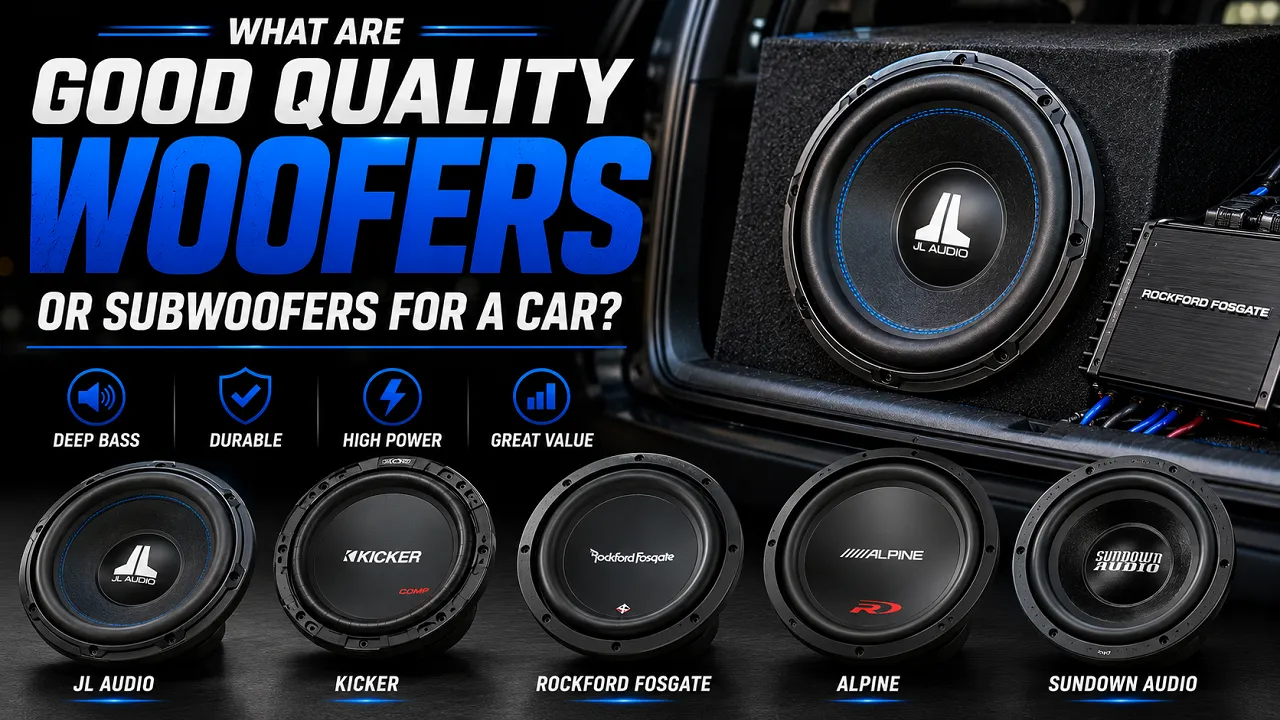
What Are Good Quality Woofers or Subwoofers for a Car? A Complete Buying Guide
If you are wondering what are good quality woofers or subwoofers for a car, the answer depends on your vehicle, music preferences, available space, and amplifier. Choosing the best car subwoofer means looking at more than brand names or maximum wattage. The right car woofer size, suitable subwoofer RMS power, and properly matched car subwoofer enclosure all play an important role in creating deep, clean, and powerful bass. A well-designed system can add impact to your music without making the bass sound muddy, distorted, or overwhelming.
What Makes a Good Car Woofer or Subwoofer?
Woofer vs. Subwoofer: What Is the Difference?
The terms woofer and subwoofer are often used interchangeably in car audio, but they do not always mean exactly the same thing.
A woofer is generally designed to reproduce low-frequency sound. Depending on its design, it may handle bass and midbass frequencies.
A subwoofer is specifically designed to reproduce the deepest bass frequencies, usually below the range handled by the main speakers.
In a typical car audio system:
- Door speakers handle vocals, instruments, and midrange frequencies.
- Woofers may reproduce midbass and lower frequencies.
- Subwoofers handle deep bass.
- Amplifiers provide the power needed to drive the system.
For most people looking to add serious low-end impact to their vehicle, a subwoofer is the better choice.
The Best Car Subwoofer Depends on Your Goals
There is no single subwoofer that is perfect for every car owner.
Someone who wants tight, accurate bass for rock and acoustic music may prefer a completely different system from someone who wants maximum output for hip-hop, EDM, or bass-heavy music.
Before choosing a subwoofer, consider:
- How much bass you want
- How much space you have available
- Your preferred music
- Your amplifier‘s power output
- Your budget
- Whether you want sound quality or maximum volume
- Whether you need to keep your trunk or cargo area usable
The best car subwoofer is the one that fits your complete system rather than simply having the highest power rating.
Choosing the Right Car Woofer Size
The car woofer size has a major effect on the way a system produces bass.
Common sizes include:
Larger does not always mean better. A properly designed 10-inch subwoofer can sound better than a poorly matched 15-inch model.
8-Inch Subwoofers
An 8-inch subwoofer is useful when space is limited.
It can add noticeable low-frequency extension without taking up much room. These subwoofers are popular in compact cars, trucks, and systems where the owner wants a subtle improvement rather than extreme bass.
An 8-inch model may be ideal for:
- Small vehicles
- Factory audio upgrades
- Compact enclosures
- Moderate listening levels
- Under-seat installations
10-Inch Subwoofers
A 10-inch subwoofer is one of the best all-around options for many daily drivers.
This car woofer size offers a good balance between output, musical accuracy, and installation space.
A quality 10-inch subwoofer can deliver:
- Tight bass
- Good musical detail
- Strong punch
- Reasonable enclosure requirements
For many people, a 10-inch subwoofer provides enough bass without sacrificing too much cargo space.
12-Inch Subwoofers
The 12-inch subwoofer is arguably one of the most popular choices in car audio.
It provides a significant increase in cone area compared with smaller models and can produce deep, powerful bass when properly installed.
A 12-inch subwoofer is a strong choice for drivers who want:
- Deep low-frequency extension
- Higher output
- Strong bass impact
- A versatile daily-driver system
For many car audio systems, a single high-quality 12-inch subwoofer offers an excellent balance of performance and practicality.
15-Inch and Larger Subwoofers
Larger subwoofers can produce tremendous output, especially when combined with powerful amplifiers and properly designed enclosures.
However, they usually require:
- More installation space
- Larger enclosures
- More amplifier power
- Stronger electrical systems
A larger subwoofer is not automatically the right choice for everyone. The vehicle and the rest of the system must be capable of supporting it.
Why Subwoofer RMS Power Matters More Than Maximum Watts
One of the most important specifications to understand is subwoofer RMS power.
Manufacturers often advertise peak, maximum, or “music” power ratings. These numbers can look impressive, but they do not always represent the amount of power a subwoofer can handle continuously.
RMS power is generally more useful when matching a subwoofer to an amplifier.
For example, a subwoofer rated at 500 watts RMS is designed to handle approximately that amount of continuous power under specified conditions.
When choosing an amplifier, the goal is to match the amplifier’s real-world output with the subwoofer’s capabilities.
A good system should avoid:
- Excessive clipping
- Overheating
- Mechanical damage
- Underpowered operation
- Poor amplifier matching
Is More Power Always Better?
No.
A 1,500-watt subwoofer is not automatically better than a 500-watt subwoofer.
Power handling is only one part of the equation.
Performance also depends on:
- Cone design
- Motor strength
- Voice coil construction
- Suspension design
- Enclosure type
- Amplifier quality
- Electrical supply
- System tuning
A well-designed subwoofer with moderate power handling can deliver excellent sound when properly matched.
Likewise, an expensive high-power subwoofer can perform poorly if it is installed in the wrong enclosure or connected to an unsuitable amplifier.
Choosing the Right Car Subwoofer Enclosure
The car subwoofer enclosure has a major effect on performance.
The same subwoofer can sound very different depending on the type and design of enclosure used.
The two most common enclosure types are sealed and ported.
Sealed Enclosures
A sealed enclosure is completely enclosed and does not use a port.
This design is often preferred by listeners who want:
- Tight bass
- Smooth response
- Accurate musical reproduction
- A compact enclosure
Sealed boxes are often easier to install and can be a good choice for daily-driver systems.
The bass may not be as loud as a properly designed ported system at certain frequencies, but the response can be smooth and controlled.
Ported Enclosures
A ported enclosure includes an opening or vent that allows air to move in and out of the enclosure.
When properly designed, a ported car subwoofer enclosure can produce greater output around its tuned frequency.
Ported enclosures are popular with listeners who want:
- More output
- Stronger bass impact
- Higher efficiency
- Deep bass at higher volume levels
However, the enclosure must be designed correctly.
A poorly designed ported box can produce unwanted noise, weak response, or excessive boominess.
Sealed vs. Ported: Which Is Better?
Neither design is automatically better.
A sealed enclosure may be the better choice for someone who values accuracy and compact installation.
A ported enclosure may be better for someone who wants greater output and stronger low-frequency impact.
The best choice depends on the subwoofer, vehicle, amplifier, and listening goals.
Cone Materials Can Affect Performance
The cone is one of the most important parts of a subwoofer.
It moves back and forth to create changes in air pressure that we hear as sound.
Common cone materials include:
- Paper
- Polypropylene
- Composite materials
- Carbon fiber
- Fiberglass
- Other specialized materials
Each material can have different characteristics related to weight, stiffness, durability, and response.
A lightweight cone may respond quickly, while a stiffer cone may resist unwanted flexing during high-output operation.
The material itself does not determine whether a subwoofer is good or bad. The entire driver design must be considered.
Voice Coil Design Is Also Important
The voice coil converts electrical energy from the amplifier into mechanical movement.
Subwoofers may use:
- Single voice coils
- Dual voice coils
- Different impedance options
A dual-voice-coil subwoofer can offer more wiring flexibility when designing a system.
However, dual voice coils do not automatically make a subwoofer louder or better.
The most important consideration is matching the voice coil configuration to the amplifier’s safe impedance range.
Incorrect wiring can cause an amplifier to operate outside its intended specifications.
Choosing Between One or Two Subwoofers
A single subwoofer can provide excellent performance.
Two subwoofers may provide greater output and can sometimes improve bass distribution throughout the vehicle.
However, adding a second subwoofer also requires:
- More space
- More amplifier power
- A larger enclosure
- A stronger electrical system
For many daily drivers, one quality subwoofer is enough.
A single well-designed 12-inch subwoofer can often deliver more satisfying bass than two poorly matched or poorly installed drivers.
Shallow-Mount Subwoofers for Limited Space
Not every vehicle has room for a large enclosure.
Shallow-mount subwoofers are designed to fit into areas where a traditional subwoofer may be too deep.
They can be useful for:
- Pickup trucks
- Compact cars
- Under-seat installations
- Factory-style upgrades
- Vehicles with limited trunk space
A shallow subwoofer may not deliver the same maximum output as a large traditional driver, but modern designs can still provide impressive bass when properly installed.
Powered Subwoofers Offer a Simple Upgrade
A powered subwoofer combines a subwoofer and amplifier in one enclosure.
This can simplify installation.
Powered subwoofers are often a good option for drivers who want:
- More bass without a complicated system
- Minimal installation space
- A factory-friendly upgrade
- A simple solution for a daily driver
They are not always the best choice for maximum output, but they can be extremely practical.
For many factory audio systems, a powered subwoofer can provide a noticeable improvement without requiring a complete system rebuild.
Do You Need a Separate Amplifier?
If you want maximum performance, a dedicated amplifier is often the better solution.
The amplifier should be matched to:
- The subwoofer’s RMS rating
- The voice coil configuration
- The final impedance
- The vehicle’s electrical system
A quality amplifier provides clean power and can help the subwoofer perform as designed.
The goal is not simply to install the biggest amplifier possible. The system should be designed so that the amplifier and subwoofer work together efficiently.
Installation Quality Matters as Much as Equipment
Even the best car subwoofer can sound disappointing when installed incorrectly.
Important installation details include:
- Correct enclosure volume
- Proper wiring
- Secure mounting
- Correct amplifier settings
- Appropriate crossover points
- Proper gain adjustment
- Adequate electrical connections
The subwoofer should also be mounted securely to prevent unwanted vibration.
The amplifier gain should not be used as a simple volume control. Incorrect gain settings can increase distortion and cause damage.
Matching the Subwoofer to Your Music
Your music preferences should influence your choice.
If you mostly listen to:
- Rock
- Jazz
- Classical music
- Acoustic music
You may prefer a controlled and musical subwoofer system.
If you mostly listen to:
- Hip-hop
- Trap
- EDM
- Dubstep
- Bass-heavy electronic music
You may want a system designed for deeper extension and higher output.
There is no single answer to what are good quality woofers or subwoofers for a car because different listeners want different types of bass.
What Is the Best Choice for Most Daily Drivers?
For many drivers, a quality 10-inch or 12-inch subwoofer is an excellent starting point.
A typical well-balanced system may include:
- One 10-inch or 12-inch subwoofer
- A properly matched mono amplifier
- A sealed or ported enclosure designed for that specific driver
- A suitable signal integration solution
- Professional tuning
This combination can provide strong, clean bass without requiring an extreme build.
The most important thing is system matching.
A good car subwoofer enclosure, suitable subwoofer RMS power, and the correct car woofer size should all work together.
When asking what are good quality woofers or subwoofers for a car, the best answer is not simply the biggest or most powerful model available. A quality system requires the right combination of subwoofer size, RMS power handling, enclosure design, amplifier output, and installation quality. For many drivers, a properly matched 10-inch or 12-inch subwoofer provides an excellent balance of deep bass, musical performance, and practicality.
The best car subwoofer is one that matches your vehicle, music preferences, available space, and amplifier. Whether you choose a compact powered subwoofer, a shallow-mount design, or a powerful subwoofer in a custom car subwoofer enclosure, careful system design will make a bigger difference than simply choosing the highest wattage rating.
Frequently Asked Questions
What are good quality woofers or subwoofers for a car?
The answer depends on your vehicle and listening goals, but quality 10-inch and 12-inch subwoofers are excellent choices for many daily drivers. The best car subwoofer should have suitable power handling, a reliable motor and voice coil, and an enclosure designed for its specifications. Proper amplifier matching and installation are just as important as the subwoofer itself.
Is a 10-inch or 12-inch subwoofer better for a car?
Both can perform extremely well. A 10-inch subwoofer usually offers a good balance of compact size and punchy bass, while a 12-inch model can produce greater output and deeper bass when properly installed. The ideal car woofer size depends on available space, amplifier power, enclosure design, and how much bass you want.
How much subwoofer RMS power do I need?
The required subwoofer RMS power depends on the subwoofer and your desired output. Many daily-driver systems perform very well with several hundred watts RMS. The amplifier should be matched to the subwoofer’s actual power-handling specifications rather than advertised peak wattage. Proper gain adjustment is also important for clean and reliable performance.
Is a sealed or ported car subwoofer enclosure better?
A sealed car subwoofer enclosure generally offers controlled and accurate bass, while a ported enclosure can produce more output around its tuning frequency. Neither is universally better. The right choice depends on the subwoofer’s design, available space, music preferences, and whether you prioritize smooth musical bass or maximum output.
Does a bigger car woofer size always mean deeper bass?
No. A larger car woofer size can provide more cone area, but enclosure design, driver construction, amplifier power, and system tuning also affect bass performance. A well-designed 10-inch subwoofer can outperform a poorly matched 15-inch model. Choosing the correct combination of components is more important than selecting the largest available subwoofer.
Can a powered subwoofer provide good bass in a car?
Yes. A powered subwoofer can be an excellent option for drivers who want a simple upgrade with limited installation space. Because the amplifier and subwoofer are designed to work together, powered systems can provide a convenient way to add bass without building a separate amplifier and enclosure system.
Should I choose one large subwoofer or two smaller subwoofers?
Either setup can work well. One high-quality subwoofer is often simpler and more practical, while two subwoofers can provide greater output and sometimes more even bass distribution. The decision depends on available space, amplifier power, and your performance goals. A single properly installed best car subwoofer can deliver excellent results.
What is more important: subwoofer brand or enclosure design?
Both matter, but enclosure design is often underestimated. Even a high-quality subwoofer can perform poorly in an unsuitable box. The correct car subwoofer enclosure must match the driver’s specifications, while the amplifier must provide appropriate subwoofer RMS power. System matching and installation quality are essential for getting the best results.