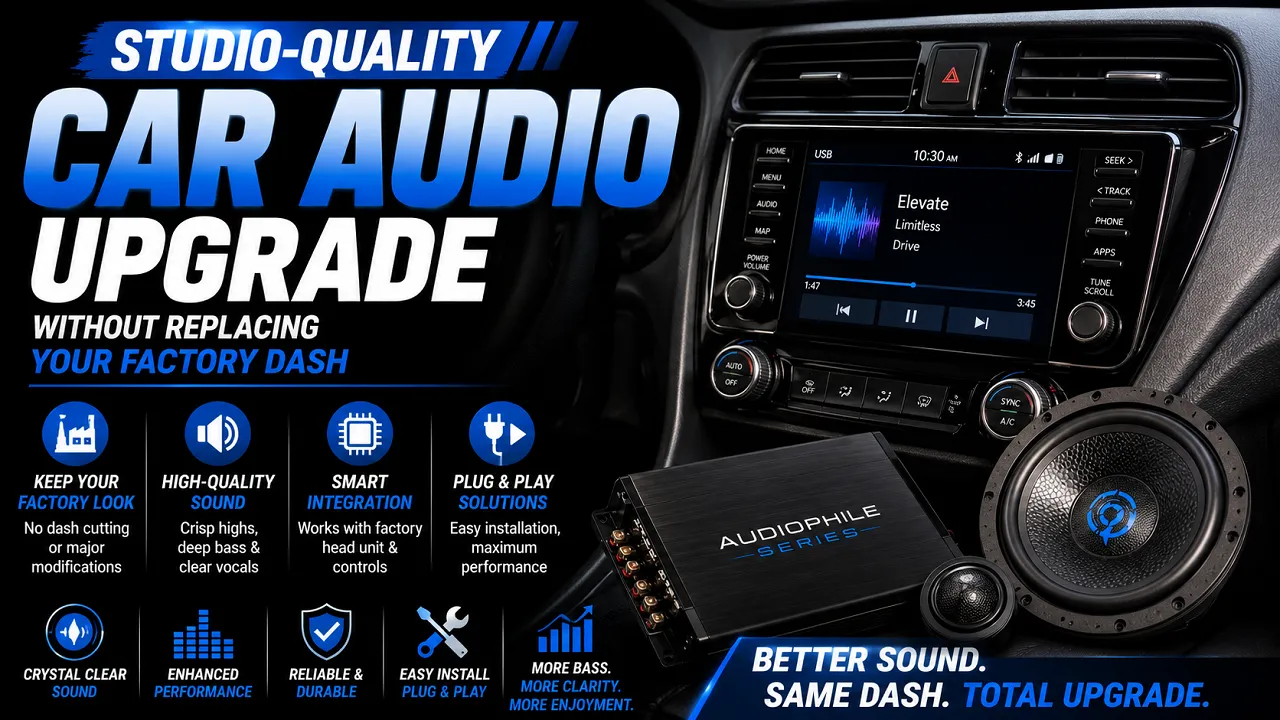
Get a Studio-Quality Car Audio Upgrade Without Replacing Your Factory Dash
A studio-quality car audio upgrade without replacing the factory dash is now the smartest way to improve sound in a modern vehicle. With a factory car audio upgrade, a properly tuned DSP amplifier for car audio, high-quality aftermarket car speakers, and professional modern vehicle audio integration, drivers can achieve dramatically better sound without removing the large screens and controls built into today’s dashboards. In fact, keeping the factory infotainment system is often the best approach because it preserves the vehicle’s original features while allowing the audio system to be rebuilt around better components.
How to Improve Modern Factory Audio Without Removing the Dashboard
Why Factory Stereo Replacement Has Become So Difficult
There was a time when upgrading a car stereo was relatively simple. An installer could remove the factory head unit, slide an aftermarket receiver into the dash, connect a wiring harness, and begin building a better system.
Modern vehicles have changed that completely.
In many new cars, the infotainment system is no longer an independent radio. Instead, it is part of a much larger electronic network that communicates with multiple vehicle control modules. The screen may control or display information related to:
- Climate control
- Navigation
- Vehicle settings
- Backup cameras
- Parking sensors
- Blind-spot monitoring
- Driver-assistance systems
- Vehicle diagnostics
- Smartphone connectivity
- Steering-wheel controls
This is especially obvious in vehicles with massive panoramic displays or large touchscreen interfaces. Removing the factory screen may also remove access to important functions that have nothing to do with music.
That is why traditional head-unit replacement is no longer the automatic solution for improving sound quality.
Fortunately, this does not mean drivers are stuck with poor factory audio.
The Factory Screen Can Stay Exactly Where It Is
The key to a successful modern audio upgrade is separating the vehicle’s control functions from the parts of the system responsible for sound quality.
Rather than removing the factory infotainment system, a professional installer can access the audio signal further down the signal chain. This allows the original screen and vehicle controls to remain in place while the audio system receives better amplification, improved speakers, advanced tuning, and additional sound treatment.
This approach offers several advantages:
- The factory display remains fully functional.
- Steering-wheel controls continue to work.
- Vehicle settings remain accessible.
- Backup cameras and safety features are preserved.
- Factory smartphone integration can remain intact.
- The audio system can still receive significantly more power and better tuning.
In other words, the vehicle does not need to be redesigned to achieve better sound. The audio system can be upgraded around the factory electronics.
The Importance of Proper Factory Signal Integration
One of the most important parts of a modern factory car audio upgrade is obtaining a usable signal from the original system.
Factory audio systems often process sound before it reaches the speakers. The signal may be divided into multiple frequency ranges, equalized for inexpensive factory speakers, or modified based on the vehicle’s interior acoustics.
For example, the factory system may intentionally reduce certain bass frequencies because the original speakers cannot reproduce them properly. If an aftermarket amplifier receives this signal without correction, the new system may simply reproduce the same limitations with more power.
That is where professional signal integration becomes essential.
Specialized integration interfaces can help installers:
- Combine multiple factory audio channels.
- Restore or compensate for missing frequencies.
- Remove factory equalization problems.
- Create clean preamp-level outputs.
- Provide appropriate signal voltage for aftermarket amplifiers.
- Maintain communication with the vehicle’s original electronics.
The goal is not simply to make the factory signal louder. The goal is to create a clean, usable foundation for the new audio system.
Why More Amplifier Power Makes a Major Difference
Many factory audio systems provide relatively modest power to each speaker. Depending on the vehicle and system design, the actual continuous output may be limited to roughly 15 to 25 watts per channel.
That may be enough for casual listening, but it leaves limited headroom.
When a song suddenly becomes louder, the amplifier needs additional power to reproduce that musical peak accurately. If the amplifier runs out of power, it can compress the signal or begin clipping.
This is particularly noticeable with:
- Deep bass
- Heavy kick drums
- Orchestral music
- Live recordings
- Rock and metal music
- Electronic music
- Vocals with strong dynamic changes
A higher-powered amplifier gives the system more breathing room. A quality amplifier producing approximately 75 watts RMS per channel can provide substantially more headroom than a typical factory system.
The result is not simply louder music.
More amplifier headroom can produce:
- Cleaner bass
- Better musical dynamics
- Less distortion
- Improved transient response
- Greater volume capability
- More effortless sound at normal listening levels
A properly designed DSP amplifier for car audio can provide these benefits while also handling advanced system tuning.
What a DSP Amplifier Actually Does
A digital signal processor, commonly called a DSP, allows an installer to adjust the audio signal with far more precision than traditional tone controls.
A DSP amplifier for car audio combines two important functions: amplification and signal processing.
The amplifier provides the power needed to drive the speakers. The DSP section allows the system to be adjusted to the specific acoustic environment of the vehicle.
This matters because every car interior creates its own set of acoustic challenges.
The windshield, seats, dashboard, doors, glass, carpeting, and hard plastic surfaces all affect the way sound travels. Reflections can create peaks in some frequencies while canceling others.
A DSP can help correct these problems through several tools.
Time Alignment
Sound from the left front speaker may reach the driver’s ears before sound from the passenger-side speaker. The difference may be only a few milliseconds, but it can affect the position and clarity of vocals and instruments.
Time alignment adds carefully calculated delays to individual speakers so the sound reaches the listening position at the correct time.
With advanced systems, adjustments can be made in extremely small increments. This helps create a more focused soundstage where vocals and instruments appear to come from a defined location rather than from individual speakers mounted around the cabin.
Parametric Equalization
A vehicle’s cabin can create frequency peaks and dips that are difficult to correct with simple bass and treble controls.
Advanced DSP systems may offer dozens of equalization bands for precise adjustments. This allows an installer to correct specific problems instead of applying broad changes that affect the entire sound.
For example, a cabin may produce excessive energy in the upper-bass region, creating a boomy or muddy sound. Careful equalization can reduce that problem while preserving the rest of the music.
Crossover Control
A DSP can also control exactly which frequencies are sent to each speaker.
The front midrange speakers may receive one frequency range. The tweeters may receive another. The subwoofer can be limited to the low frequencies it is designed to reproduce.
This creates a more organized system where each speaker works within a range that matches its design.
Upgrading the Speakers Can Transform the System
Amplification and signal processing are important, but the speakers remain the final component that converts electrical energy into sound.
Many factory speakers are built to meet cost, weight, and packaging requirements. They may use lightweight paper cones, relatively small magnets, and basic materials that are adequate for everyday listening but limited when pushed hard.
High-quality aftermarket car speakers are designed with different priorities.
Depending on the model, upgraded speakers may use:
- Polypropylene cones
- Carbon fiber materials
- Composite cone structures
- Silk dome tweeters
- Aluminum tweeters
- Stronger magnet assemblies
- Improved voice coils
- More durable suspension systems
These improvements can help the speakers remain more stable when reproducing demanding music.
A quality woofer, for example, may provide better control during large cone movements. A better tweeter may reproduce high-frequency detail with greater smoothness and extension.
The result is often a system that sounds clearer, more balanced, and more detailed even before the volume is increased.
Component Speakers Improve Imaging and Detail
Many premium aftermarket car speakers use a component design.
A component system separates the woofer and tweeter instead of placing them together in a single coaxial speaker. The system may also include a passive crossover network to direct the correct frequencies to each driver.
This arrangement gives the installer more flexibility when positioning the speakers.
The woofer can focus on midrange and lower frequencies, while the tweeter handles high-frequency information. When installed and tuned correctly, the system can create better separation between instruments and a more realistic front soundstage.
This is particularly important for listeners who want to hear details such as:
- Vocal texture
- Acoustic guitar strings
- Cymbals
- Piano notes
- Room ambience
- Subtle recording effects
The goal is not simply to make every frequency louder. A properly designed system should make the music easier to understand and enjoy.
Why Factory Speaker Location Is Not Always the Problem
Some vehicle owners assume they need completely new speaker locations to achieve better sound.
In many cases, that is unnecessary.
A skilled installer can often achieve significant improvements using the original speaker locations. The biggest gains may come from combining better speakers, more power, DSP tuning, and proper installation techniques.
However, speaker positioning can still matter.
The installer may evaluate:
- The angle of each speaker
- The distance from the listener
- The size of the factory speaker opening
- Door construction
- Available mounting depth
- The location of the factory tweeter
The objective is to work with the vehicle rather than making unnecessary modifications.
Sound Treatment Helps Control the Vehicle Interior
Even the best speakers can lose performance when installed in a noisy or resonant environment.
Vehicle doors often contain large metal panels that can vibrate. These panels may produce unwanted noise or absorb energy that should be directed toward the listener.
Sound treatment can help improve the performance of an audio system by reducing unwanted vibration and improving the environment around the speaker.
Common treatment areas include:
- Inner door panels
- Outer door skins
- Speaker mounting surfaces
- Trunk panels
- Rear quarter panels
The treatment approach depends on the vehicle and the goals of the system.
A properly treated door can provide a more stable enclosure for the speaker. This may improve midbass response and reduce rattles.
Professional Testing Is Essential for Modern Integration
Modern vehicles contain sensitive electronic systems. That makes professional installation especially important.
Before connecting aftermarket equipment, an experienced installer may evaluate the factory audio signal using specialized test equipment.
Measurements can help determine:
- Signal voltage
- Frequency response
- Channel configuration
- Factory equalization
- Signal timing
- Amplifier behavior
This information allows the installer to design the system around the vehicle rather than relying on guesswork.
Professional modern vehicle audio integration also requires an understanding of how the factory electronics communicate with aftermarket equipment.
A properly designed system should preserve important features such as:
- Steering-wheel audio controls
- Factory volume controls
- Speed-sensitive volume functions
- Vehicle alerts
- Factory infotainment access
This is one of the biggest differences between a carefully engineered upgrade and a basic component replacement.
Building a Complete System in Stages
Not every vehicle owner needs to upgrade everything at once.
A factory car audio upgrade can be completed in stages depending on the budget and the desired result.
A common upgrade path might look like this:
- Improve the factory signal integration.
- Add a DSP amplifier for car audio.
- Upgrade the front speakers.
- Improve door or trunk sound treatment.
- Add a properly matched subwoofer system.
- Complete final DSP tuning.
This approach allows the system to improve over time.
For some drivers, better front speakers and amplification may provide the biggest improvement. Others may want deep bass and choose to add a subwoofer early in the process.
The correct upgrade path depends on the vehicle, factory audio system, music preferences, and budget.
Why You Should Avoid Replacing Technology That Still Works
The factory screen may not produce the best sound by itself, but it often performs many important functions extremely well.
Removing it can create unnecessary complications.
A modern modern vehicle audio integration strategy allows the factory system to continue doing what it was designed to do while aftermarket equipment handles the parts where it is weakest.
This approach is especially valuable in newer vehicles where the infotainment display is connected to safety and convenience systems.
Instead of fighting the vehicle’s electronics, a professional installer works with them.
That makes the installation cleaner, more reliable, and less likely to interfere with factory functionality.
The Best Upgrade Depends on the Vehicle
There is no universal audio upgrade that works perfectly for every vehicle.
A compact car with a basic factory stereo may need a completely different solution than a luxury SUV with a premium multi-channel audio system.
Before choosing equipment, an installer should consider:
- The vehicle’s factory audio architecture
- Number of factory channels
- Factory amplifier location
- Speaker sizes
- Available installation space
- The owner’s music preferences
- Desired listening volume
- Budget
- Future upgrade plans
This is why professional system design is so important.
A high-quality audio system is not created by simply selecting the most expensive amplifier or speakers. The components must work together.
A studio-quality car audio upgrade without replacing factory dash technology is no longer a compromise. With the right signal integration, a powerful DSP amplifier for car audio, high-quality aftermarket car speakers, sound treatment, and careful modern vehicle audio integration, today’s drivers can achieve a major improvement in clarity, detail, imaging, and bass while keeping the original dashboard completely intact.
The smartest approach is usually to preserve the factory infotainment system and upgrade the components responsible for sound reproduction. This allows you to keep the screens, controls, cameras, and vehicle functions you already use while building a much more capable audio system behind the scenes.
Frequently Asked Questions
Can I get a studio-quality car audio upgrade without replacing the factory dash?
Yes. A studio-quality car audio upgrade without replacing factory dash components can be achieved by integrating with the original infotainment system. A DSP, upgraded amplifier, better speakers, and proper tuning can dramatically improve sound quality while keeping the factory screen, vehicle controls, cameras, and other integrated features fully operational.
What is the best first step for a factory car audio upgrade?
The best first step is understanding how the factory system processes and distributes its audio signal. A professional installer can identify the signal path, factory equalization, amplifier configuration, and speaker limitations. From there, the upgrade can be designed around the vehicle instead of replacing components without knowing how they interact.
Why is a DSP amplifier for car audio useful?
A DSP amplifier for car audio combines amplification with advanced signal processing. It can provide more power while also correcting timing, frequency response, crossovers, and other acoustic problems. This allows the system to be tuned specifically for the vehicle’s cabin and listening position.
Are aftermarket car speakers always better than factory speakers?
Not automatically, but quality aftermarket car speakers are often designed with stronger materials, better motor structures, and improved power handling. Their performance depends heavily on installation, amplification, and tuning. A properly matched speaker upgrade can provide clearer vocals, better detail, improved midbass, and greater durability.
Can I keep my factory touchscreen after upgrading the audio system?
Yes. In most modern vehicles, keeping the factory touchscreen is one of the main advantages of a professional upgrade. Proper modern vehicle audio integration allows aftermarket amplifiers and speakers to work with the original infotainment system while preserving factory controls and important vehicle functions.
Does adding more amplifier power automatically make the system sound better?
No. More power alone does not guarantee better sound. The amplifier must be properly matched to the speakers and integrated with the factory signal. A DSP amplifier can be especially helpful because it combines additional power with the tuning tools needed to correct frequency response, timing, and crossover problems.
Is sound treatment necessary for a factory car audio upgrade?
Sound treatment is not always required, but it can significantly improve the results. Treating door panels can reduce vibration, minimize rattles, and create a more stable environment for the speakers. The amount of treatment needed depends on the vehicle and the goals of the factory car audio upgrade.
Can a professional installer upgrade a luxury vehicle’s complicated audio system?
Yes. Experienced installers can work with many complex factory systems using specialized integration equipment and measurement tools. The exact solution depends on the vehicle’s electronics, factory amplifier design, speaker configuration, and available installation locations. Professional modern vehicle audio integration helps ensure the new system improves sound without disrupting factory features.
If you want, I can also create a more aggressive SEO version, a more natural editorial version, or a Pinterest-focused version with a title, description, tags, and alt text for this article.